
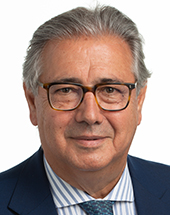





| Rank | Name | Country | Group | Speeches | |
|---|---|---|---|---|---|
| 1 |
|
Lukas Sieper | Germany DEU | Non-attached Members (NI) | 390 |
| 2 |
|
Juan Fernando López Aguilar | Spain ESP | Progressive Alliance of Socialists and Democrats (S&D) | 354 |
| 3 |
|
Sebastian Tynkkynen | Finland FIN | European Conservatives and Reformists (ECR) | 331 |
| 4 |
|
João Oliveira | Portugal PRT | The Left in the European Parliament (GUE/NGL) | 232 |
| 5 |
|
Vytenis Povilas Andriukaitis | Lithuania LTU | Progressive Alliance of Socialists and Democrats (S&D) | 227 |
All Contributions (90)
Rail transport safety in the EU – lessons learnt from the Adamuz accident and three years after the Tempi tragedy (debate)
Madam President, Commissioner, today I can only begin by recalling the victims of the accident, the forty-six who died, the more than one hundred and fifty injured, and their families, and also by recalling with great pride the people of Adamuz, who in the toughest hours showed more humanity, more efficiency and more dignity than the entire Government of Spain, a Government that has replaced management with propaganda, headed by a minister more concerned with social networks than with railway networks. In any democracy, an accident of this gravity would be a provocation for us to ask ourselves three questions immediately: What did you know, who knew, and why didn't you act? In Spain, two months later, Commissioner, we still have no answer. The victims deserve justice, their families deserve to know the truth, and we Spaniards deserve a government that is up to par, because, when a government like Sanchez's does not protect its citizens, it is not worth any excuse, only the responsibilities are worth it, and the time has come to assume them. No matter how many obstacles you want to put in place, rest assured that we will reach the end for the truth and for the dignity of the victims.
Spain’s large-scale regularisation policy and its impact on the Schengen Area and EU migration policy (debate)
Madam President, I think we need to be clear: The regulation proposed by Pedro Sánchez is the umpteenth smokescreen of a corrupt and dying government. As much as some have kept here, Sanchez doesn't care about immigrants. All he wants is for us to stop talking about his scandals. But, even thinking that it is a well-intentioned measure, its design can not be more wrong. First, only five months are required to stay in Spain, a period of time in which it is difficult to speak of rootedness or integration. Second, a mere statement of responsibility is sufficient to establish that a person does not pose a security risk, without even requiring his criminal record. And, in addition, this measure will pass without going through Congress, depriving democratic representatives of their ability to decide. As St. Vincent de Paul said, "It is not enough to do good, you have to do good." And this regularisation sends the message that bypassing Spanish and European laws is a good shortcut, that it is not necessary to comply with our rules and that, therefore, all irregular immigrants are welcome to Europe. This not only generates an obvious so-called effect, but also encourages the business of mafias that traffic in human beings. From the Popular Party we defend a diametrically opposed model: a legal and orderly migration policy that respects the rule of law and respects our European partners.
Building a stronger European defence in light of an increasingly volatile international environment (debate)
No text available
Extreme weather events in particular in Portugal, southern Italy, Malta and Greece: European response in strengthening readiness, preparedness and solidarity mechanisms (debate)
No text available
Drones and new systems of warfare – the EU’s need to adapt to be fit for today’s security challenges (debate)
Mr President, Madam Vice-President, as early as 1903 the New York Times He claimed that flying machines were unnecessary inventions and predicted that it would take between one and ten million years to become a reality. Just two months later, the Wright brothers successfully made the first flight in history. A few years later, the airstrike on Pearl Harbor made it clear that these flying machines were not only a reality, but the decisive factor that would determine victors and vanquished in the wars of the twentieth century. Well, something similar is happening in the 21st century with drones. Ukraine is being a dramatic example of this. According to numerous analysts, more than 70% of the casualties of the war in Ukraine have been caused by drones, but their impact is not limited to the battlefield: We have also seen Russian drones prowling critical European infrastructure, spying on military bases or disrupting traffic at our airports. Europe therefore needs to respond urgently to this threat. The industrial projects we are developing, such as the Eurodrone, are years behind schedule, and the so-called "anti-drone wall", which will be launched in the coming weeks, is a good starting point, but it will not be fully operational for two years. We need, Madam Vice-President, to accelerate and escalate. Ukraine is being able to produce up to five million drones a year, while the entire European Union is currently barely 10%. We Europeans have a lot to learn from the Ukrainian drone industry, with increased investments in innovation, much stronger supply chains and permanent coordination between industry and the armed forces. Ukraine already lived in 2022 its particular Pearl Harbor (of drones, in this case). We must ensure that the European Union never suffers. This is what we have suggested in the INI procedure that we are approving today.
European Democracy Shield – very large online platform algorithms, foreign interference and the spread of disinformation (debate)
No text available
EU Defence Readiness (joint debate)
No text available
Incentivising defence-related investments in the EU budget to implement the ReArm Europe Plan (debate)
Madam President, Commissioner, we Europeans have taken the challenge of defence seriously, a seriousness that is reflected in an unprecedented budgetary commitment: EUR 800 billion of investment. But investing is not enough: we must do so in a much more efficient and coordinated way, avoiding duplication. At present, the armed forces of the members of the European Union have invested in more than ten types of combat aircraft, up to 14 different tanks and more than 20 different frigates. For comparison, the United States has focused its investments on a fighter jet, a tank model and a reference frigate. Therefore, if we want to make these investments fully profitable, we need less fragmentation and more real cooperation. I am thinking in particular of the future European fighter, the FCAS, a project promoted by France, Germany and Spain to transform the capabilities of air combat in the European Union. Well, instead of having become a priority project, today it is at risk because of industrial disputes between Paris and Berlin. Its cancellation would be a collective failure and a missed opportunity for European strategic autonomy. The future of European defence is not just an accounting issue: It requires political will, strategic vision and joint work. Without this shared ambition, no investment will be enough to ensure security in Europe.
EU response to the continuous airspace violations and sabotage of critical infrastructure in the EU originating from Russia and Belarus (debate)
No text available
Effective use of the EU trade and industrial policy to tackle China’s export restrictions (debate)
Mr President, Commissioner, Europe's response to growing trade frictions with China must be threefold: dialogue, defend and diversify. First, dialogue. Because our prosperity, like China's, depends on trade, and we are simply doomed to understand each other. That is why we must avoid escalations of tension that are mutually damaging. In this regard, we welcome Beijing's decision to lift controls on some minerals, but we must continue to work to remove the remaining restrictions that limit our industrial capacity. Second, defend. Europe cannot accept trade being used as a political weapon. We Europeans have enough tools in our commercial arsenal to prevent it, but we must use them in a more coordinated and faster way in defence of our interests. And thirdly, diversify. The best defense of our autonomy is not autarky, but broader and more balanced integration into global supply chains. We need to extend our network of suppliers of critical raw materials in Ibero-America and Africa and strengthen alliances with partners such as Japan, Canada or Australia. In short, it is not a question of confronting China, but of building a more balanced, more predictable and stronger relationship. A relationship in which trade can be a genuine source of shared prosperity and not a mechanism to exploit our vulnerabilities.
Communication on the Democracy Shield (debate)
Mr President, Commissioner, information manipulation effectively undermines trust in our institutions and weakens democracy. We take good note of the recommendations in your report, but also of those you have made here today in this rostrum. But in Spain, unfortunately, much of the information manipulation emanates from the government itself. In recent months, President Sanchez has embarked on a very dangerous drift, unbecoming a European democracy. It is turning public television into an instrument at its service, from which it systematically defames the opposition. He is handing out cards of good and bad journalists, branding the press critical of his government as pseudo-media and automatically disqualifying any unfavorable information by branding it a hoax. According to Sanchez, it was a hoax he knew about the corrupt Koldo and Aldama. It was a hoax that his wife was being investigated for influence peddling and misappropriation. And it was a hoax that his right hand of the Socialist Party, Santos Cerdán, participated in one of the most serious corruption plots in the recent history of Spain. But the reality, ladies and gentlemen, is that the free press and independent justice are proving that none of this was a hoax, but a dramatic reality. There is only one hoax left to deny: whereas the leader of all of them knew absolutely nothing about what was happening in his own government, in his own party, in his own home; not even in his own Peugeot.
European Defence Industry Programme and a framework of measures to ensure the timely availability and supply of defence products (‘EDIP’) (debate)
Madam President, the creation of this European Defence Industry Programme is good news for Europe, an important step in strengthening and modernising our armed forces. But if we truly aspire to have an effective deterrent capacity and, ultimately, a credible defence, we must significantly raise our level of ambition. Russia, of course, is doing it. All the data suggest that Putin is preparing for a larger conflict by sending drones to inspect military bases and critical infrastructure throughout Europe, producing much more weaponry than he needs for the Ukrainian front and increasing the size of his army to reach two million troops by 2030, twice as many as at the beginning of the invasion of Ukraine. Well, EDIP was born with a budget of 1.5 billion euros, just one hundredth of Putin's annual defense budget. We are heading in the right direction, but we need more investment, more speed and more ambition.
Breast cancer: the importance of screening (debate)
Madam President, I would like to begin my speech by showing my solidarity with all the women affected and with their families, which is what the Junta de Andalucía and Juanma Moreno have done: apologise, debug political responsibilities, appoint a new counsellor and, more importantly, devise a shock plan to treat the women affected – with a real budget – and revise the protocols so that it does not happen again in the future. Mrs Gálvez, I have had the opportunity to listen to you carefully. You speak of manipulation: you, who were precisely part of the government that was hiding the waiting lists – more than 500 000 people! talks about defending health workers: you, who were part of the government that expelled 7,700 professionals and lowered their salaries. Faced with this partisan and petty propaganda, some data: the health budget has increased by 55% in Andalusia since Juanma Moreno arrived and the workforce has increased by 28,000 professionals. Two historical challenges. I recommend one thing, Spanish socialists, leave the cheap and petty propaganda and put yourself at once – without using women – to work for the Andalusians and for the Spaniards.
The ongoing assault on the democratic institutions and the rule of law in Bulgaria (topical debate)
Madam President, Commissioner, as a career judge I have always argued that the separation of powers is not a mere formality, but an inviolable principle. It is the pillar that sustains our democracies and the ultimate guarantee that justice acts independently, without political or partisan pressure. It has to be independent. That is why we must acknowledge the progress Bulgaria has made in this area. The European Commission's latest Rule of Law Report highlights improvements in its judicial independence, in the accountability of the Prosecutor General and in the efforts of the Supreme Judicial Council and anti-corruption mechanisms. And we'll have to move on. Thanks to the responsible policies of the GERB and Boiko Borisov, Bulgaria is now part of Schengen and will join the euro area in the coming months. These achievements reinforce European commitment and institutional stability. Neither this Parliament nor the national government should interfere in ongoing judicial proceedings, such as that of the mayor of Varna. Defending the rule of law is not about delivering judgment from this rostrum, but about ensuring that judges can deliver judgments free from any pressure.
United response to recent Russian violations of the EU Member States’ airspace and critical infrastructure (debate)
Madam President, Commissioner, in a matter of weeks, Russian drone incursions into European airspace have become more frequent and more daring. They are no longer launched only from Russian soil, they now take off from the hundreds of ghost ships that surround our shores. Drones no longer arrive solely from the east, they now do so from all directions. What began in Poland is now spreading throughout Europe. Copenhagen and Munich airports have been forced to close, leaving tens of thousands of passengers ashore. Unidentified drones have been located while flying over military bases in Brussels, and I'm afraid it's only a matter of time before they reach southern Europe. Putin intends to test our commitment to collective defence and is fully aware that every European hesitation is a Russian victory. That is why we have an obligation to react firmly, to react together, because no one is far enough away. No one is safe enough.
China’s unjustified decision to impose duties on imports of pork products from the EU and the need to support European farmers and workers (debate)
Mr President, Commissioner, imposing Chinese tariffs on European pig exports is an additional challenge for a sector that has already been facing difficulties. In 2020, 50% of Spanish pig exports were destined for China worth more than €3 billion. Four years later – and with trade pressures in between – this share has plummeted to 20%. With these data it is clear that the new tariffs do not meet technical criteria, but are framed in a climate of instrumentalization of trade. It is no coincidence that they are adopted after the European Union imposed tariffs on Chinese electric cars, a measure that has already reduced its market share in Europe by 4%. That is why I call on the Commission to continue to defend our producers – as it has already done in the cases of dairy and brandy – and, to that end, to strengthen the trade dialogue with China and to agree on a solution that guarantees the stability of the sector.
Implementation of EU-US trade deal and the prospect of wider EU trade agreements (debate)
I will not go into the disqualifications they make of those who have been democratically elected president of a state. That experience that you had when you were young maybe I could have had it too, but there is something that is very clear: it has been possible to reach an agreement under very difficult conditions - as I just said in my speech - and we have to make an effort to leave absolutely no one behind. What did we have? I believe that it wins in predictability - there is no doubt that this is the case - companies know what to expect, and we will have a better treatment than other nations. But there is something that also worries me a lot: the circumstances we might have if this agreement had not been reached. There are things that are even worse, that is why we are going to try to do everything possible and not what cannot be achieved, because we have to be reasonable. And I'll guarantee you one thing: I have always argued that humiliation is not the way to walk through life, so neither in politics. Humiliations, none.
Implementation of EU-US trade deal and the prospect of wider EU trade agreements (debate)
Mr President, I think it is becoming clear that the agreement with the United States is not what we Europeans would have wanted, but, as Bismarck said: Politics is the art of the possible, not the desirable. The agreement reached is probably the best possible with the current Trump Administration: with it we avoid a major clash with our main trading partner and gain certainty for our producers. For all these reasons, we value the work of the negotiating team in a clearly adverse context. However, there are still fundamental problems that we have to try to solve: Tariffs on steel and aluminium continue to threaten our industry and sectors such as agri-food could lose competitiveness if we relax the rules for the entry of American products. If certainty is the argument in favour of this agreement, we need it for all sectors and for it to be prolonged over time. Europe cannot settle for half-measures: If this is the agreement chosen to defend our interests, we cannot leave any sector behind.
EU-US trade negotiations (debate)
Mr President, Commissioner, we have three weeks to reach a tariff agreement with the United States, but we must not accept a "salvese" negotiation in which we try to save some sectors while others are unfairly punished, especially when it comes to sensitive sectors such as agriculture, especially with products, such as olive oil or wine, so dependent on the US market. I must confess that I am very concerned about Spanish products, products that have been in the spotlight since Mr Trump discussed with Pedro Sánchez – or had different points of view – and since he refused to contribute financially to NATO like the rest of the partners. I sincerely hope that Spanish producers will not end up paying for Mr Sánchez's lack of solidarity. But beyond the specific tariff threshold, we need to put an end to this uncertainty that is already hurting exporters and importers and is putting both future investments and new hires on hold. We need to ensure that the agreement is robust and durable over time, so that no new concessions are demanded from the White House or threatened with new tariffs in a matter of months. We therefore need a definitive solution, we need to restore stability for producers on both sides of the Atlantic, but, above all, we need to restore confidence in trade as a source of shared prosperity.
Preparation for the 2025 EU–China Summit - Tackling China's critical raw materials export restrictions
Madam President, in two weeks' time we will hold a historic summit: the 50th anniversary of the establishment of diplomatic relations between the European Union and China, which have brought trade benefits by promoting investment and creating jobs. But in recent years, the relationship has accused a turbulent geopolitical concept, as well as the emergence of growing asymmetries. That is why this Summit – beyond the anniversary – must serve to rebalance this relationship with reciprocity as a basis. First, we must work to maintain the multilateral international order and institutions such as the WTO. Secondly, we must stop the negative impact of industrial overcapacity. We have to put an end to artificially low prices that prevent our companies from competing on an equal footing. Thirdly, we need to tackle unsubstantiated investigations into European products as sensitive as pig products. brandy or dairy. Fourthly, we need to bring about an end to selective restrictions on the export of critical raw materials that jeopardize our own economic security. And finally, we must move towards a more responsible position on the part of China in the framework of the war in Ukraine. Based on these premises, China and Europe will be able to take a renewed momentum and ensure that the relationship continues to be mutually beneficial. We cannot and must not miss this opportunity.
Safeguarding the rule of law in Spain, ensuring an independent and autonomous prosecutor's office to fight crime and corruption (debate)
Mr President, Commissioner, I would need at least an hour to be able to list Pedro Sánchez's attacks on the rule of law in Spain, but I only have one minute. A minute to denounce that Spain is experiencing an unprecedented crisis of gravity: a prosecutor-general of the State prosecuted for his political interferences – prosecuted; judges and prosecutors who are engaged in a historic strike in the face of the assault they are suffering; a government that persecutes judges investigating the trappings of the president’s family; a Socialist Party that has tried to decapitate the anti-corruption unit of the Civil Guard, which was investigating its mafia practices ... not to mention the scandalous plot of bites and bribes of the top socialist leaders. Spain is reaching the limit. The institutional seams of our country are about to burst. It is time to stand up to Sanchez's corruption and institutional degradation. Above all, the European institutions can no longer tolerate...
Upcoming NATO summit on 24-26 June 2025 (debate)
Madam President, Mrs Kallas, congratulations. Next week's NATO summit should mark a turning point. We Europeans must demonstrate our strategic coming of age and our responsibility for self-defence. Unfortunately, not all partners seem willing to do their part. The government of my country, Spain, has already declared that raising defence investment to 5% of GDP is a huge mistake and that 2% is more than enough, but I could not be more wrong. The 2% target corresponds to a very distant reality: the reality of 2014. A decade later, the war has reached the gates of the European Union and flies over our eastern flank. There are attacks on our critical infrastructure, from submarine cables to hospitals. We have reached a record number of cyberattacks, up to 45,000 every day, in Spain alone. That's why we can't hide our heads. It is time to be responsible, to speak to citizens as adults, and to invest in a safer Europe.
A unified EU response to unjustified US trade measures and global trade opportunities for the EU (debate)
Mr President, ladies and gentlemen, the fact that tariffs lead us to disaster is no surprise. The most basic economic theory says it, the history of international trade says it and now the data confirm it again. The price of the products concerned has increased by around 12% for consumers. If this increase continues, it will cause a loss of 7.3 billion dollars per year, something that is already being noticed in employment with the destruction of 40,000 jobs on the other side of the Atlantic. The failure of tariffs is therefore already evident. That is why the suspension has finally been a rational measure on the part of Mr. Trump, necessary for both Americans and Europeans. But we can't settle for it: we need its final elimination, including the 10% rate, which is still in force. We cannot allow the tariff threat to hang over our heads like a sword of Damocles. We cannot continue to jeopardise the legal certainty of hundreds of thousands of European producers.
European Steel and Metals Action Plan (debate)
Madam President, Commissioner, two billion tonnes. This is the amount of steel that has been produced in 2024. A real tsunami of metal that, far from being reduced, is expected to increase an additional one hundred and forty million next year. An exorbitant overcapacity that has brought down prices and is dynamiting the European market. And, as if that were not enough, the United States has reactivated its tariffs and countries such as Turkey, Canada or South Africa have imposed new trade barriers. Protectionist measures that will help redirect this oversupply to the European market, further undermining the competitiveness of our producers. That is why we believe that the Action Plan proposed by the Commission is a step in the right direction, but it is not enough. We cannot continue to patch a safeguard that does not respond to the current reality of the market. We need a new instrument to provide structural solutions to the crisis in the sector, and we need it now. If we keep waiting until mid-2026, it will be too late for many factories and for many of our workers.
White paper on the future of European defence (debate)
Mr President, Commissioner, after a few weeks of geopolitical storm, few doubt that we need a strong, joint and well-funded European defence. However, there are still some, from the left, who present a dichotomy as false as dangerous: We either invest in hospitals or we invest in tanks. Ask the Ukrainians, who suffered hundreds of bombings and cyberattacks in their hospitals, what they think of their dichotomy. Ladies and gentlemen, putting public opinion at this crossroads is, in addition to an attempt to infantilise it, irresponsible at a critical moment for our democracies. The future of European defence will require efforts, such as new budget items, better use of existing resources and closer cooperation with our partners. But no one here is talking about eliminating social protection, pensions or health care. As much as Sanchez and Zapatero say, we have neither the Ministry of Defense nor the Army. Investment in defense is not only necessary, but it is the best shield to continue enjoying the welfare state.